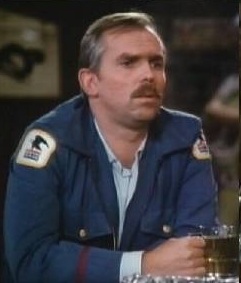
Tuesday, February 28, 2012

Shouldn't Every Day Be Diane Chambers Day?

The season four finale of Cheers is a three-parter. This seems to be the norm with this show as the last two seasons had multipart finales and from the snooping around I did before starting this blog, the show ends with a three-part series finale as well.

Before getting to the finale, however, the show decides it wants to throw in as many curve balls as possible in regards to the SamAndDianeWillTheyWontTheyMelodrama. Throughout the season, Frasier has had to come to terms with losing Diane, which he seemingly ends up doing. Sam, meanwhile, convinces himself they are through but both he and Ms. Chambers exude a “never say never” attitude throughout the season.
Still, everything seems to be on an even keel. That is until a mysterious, never-before-referenced ex of Diane’s shows up in Boston. Before he comes by Cheers, the gang have some questions, leading to this exchange:

Diane: He's a man I dated for a bit in Europe.
Woody: Is that before or after you dumped doctor crane and sent him into an alcoholic tailspin?
Diane: After...
Frasier (standing right behind an unbeknownst Diane): How long after?!?

The old flame, simply known as Jack, is a mature, bearded and manly fellow whom Diane spent time with in and around Europe, supposedly. Additionally, he’s the exact image I see when I think of myself.


Loud, boisterious, and jolly, Jack takes no time to meet everyone at the bar and challenge Sam to an arm wrestling contest. Within 20 seconds of him being on screen, Sam and the Fras bond over their mutual hatred for the guy.

Not only is this dude a world traveler, but he's also a pilot (again, the exact image of how I view myself). So, naturally, the episode focuses on this ex-BF of Diane's taking her and Sam up in his plane. He has the two handle the controls while he checks out something in the back. And, in the nature of things, he dies, leaving S and D scared, crying, and fearing for their lives as they struggle to handle the controls. In the heat of the moment, they admit to still being in love and vow to marry should they survive.

And, once more in the nature of things, Jack wakes up, pronouncing he was pretending to be dead so that Sam and Diane could realize what they mean to each other. Fair enough, I guess...

The next episode is the oddly titled "Banditos (AKA Diane Chambers Day)" in which Sam and Co. finally feel bad for not accepting Diane as "one of the gang" after four years of working at the bar. This epiphany comes about after Sam invites everyone but her over to his place to watch a movie, leaving Ms. Chambers to feel like an outsider.

To make up for the slight, the gang -- which should be noted does seem to officially include Frasier -- decide to plan a day around Diane's interests rather than sports games. The group struggles to get a plan together until Frasier mentions that Diane's favorite opera is being shown in Boston and he could look into getting tickets for everyone. Carla, naturally, doesn't attend, while Frasier for some reason doesn't go either. This leaves Diane to be escorted by Sam, Woody, Norm and Cliff for her night out on Diane Chambers Day.

As you can see below, the gang are seated in a balcony box. And, naturally, display their fish-out-of-waterness within seconds of the opera beginning as Norm cracks open a beer. (Alcoholism: Hi-larious!)


The episode ends back at the bar with a scene not unlike that in the season 1 and 2 finales. Sam and Diane close up shop, with Diane still belieivng Diane Chambers Day and the opera trip were Sam's ideas. She drops her purse and, as they both bend down to pick it up, the two lock lips.

It's a lot of the same ole, same ole to be sure, but what's redeeming about the scene is Sam's admission that the ideas were Frasier's, not his own. He's begun to grow as a womanizing, good-timing tom cat. And that's just the kind of character development that's made this season so interesting... and impossibly long to get through and blog about.

Tuesday, February 21, 2012

Things Get Real for Mayday

At the end of the day, Cheers is a series about a bar, it’s owner and his waitstaff, and the drunks they serve. That said, it’s also really, really good.

I say this not based on the show’s reputation and lasting relevance, but on the strength of this fourth season which has taken me an eternity to finish. The whole Frasier meltdown intertwined with the SamAndDianeWillTheyWontTheyLoveDrama has been interesting to watch. Yet the more dramatic elements of the show have been spaced out enough this season that when they do occur, they seem to hit with a poignancy that’s atypical of sitcoms.

One great example of the show blending typical comedy with drama is the aptly titled “Dark Imaginings” in which Sam and Woody go head to head in racquetball. This, of course, comes about when Sam gets the impression people think Woody is more athletic and younger than he is. The problem, of course, is that Woody is more athletic and younger than Sam.

Mayday ends up with his whole body aching, leading to some rare physical comedy on the part of Ted Danson. Cue laugh track, end of show, right? That’s exactly where a show like, say, Everybody Loves Raymond would call it a day. Yet, Cheers takes it a step further with Sam not only going to the hospital with a hernia, but also going to great lengths to hide his injuries from the other characters.

Back at the bar, Diane overhears a table of nurses talking about a sexy patient they’ve been looking after named “Lance Manyon.” Diane drops a glass and declares, “My God, it’s Sam!”

Concerned, Carla, Woody, and Diane visit Mayday. Once the others leave, Diane talks Sam into letting her read for him. He agrees and lets her sit on his bed before slowly creeping away and pushing an end table against the hospital room door. Diane continues reading as Sam lowers the lights and shuts the curtains. Once aware of what ole’ Mayday is up to, Diane explains things will not be going how Sam intended. “This is a once in a lifetime chance to play doctor in a real hospital!” Sam protests, to no avail. Instead, his once (and probably future) lover takes pity on him by explaining he doesn’t have to use his libido to prove to himself he’s still young. Rather, Ms. Chambers argues, growing old is a good thing, particularly for men who she says become more distinguished in mid-life.

From here, Diane bids Mayday adieu and Sam is greeted by a roommate who recognizes him from his Red Sox days. The two have a conversation about accepting being in middle age before the new roommate is greeted with his own guest. She’s introduced to Sam and the three continue to make small talk for a minute before, naturally, Mayday hits on her and tells her if she’s everything thinking about leaving her boyfriend she can call up Sammy any time.

I should reiterate that last season on his way to break-up Diane’s wedding to Frasier, Sam hit on the stewardess of his flight. It makes perfect sense for him to hit on the wife/girlfriend of one of his fans. Worse than a casual rejection to his causal proposition, Mayday is hit with being told matter-of-factly that the woman is not the guy’s girlfriend, but his daughter. The two look down on Sam for his audacity and leave the room for a walk.

The studio audience gets a get laugh out of this, sure, but it leads to a great image in which Sam sits down at the chair near the window and looks out over the Boston night sky. No more laughter. No applauding. Just the audience looking at the main character of a sitcom being hit with the cold hard truth that he’s a tomcat for whom life just may have passed by.

Wednesday, February 8, 2012

Things Are Looking Up for the Fras...

It's taken me forever to get through season 4 of Cheers. This has been for a number of reasons, such as my other professional obligations.

But perhaps one of the reasons it's taken me months to get through this season is the fact that Frasier's downfall is (pathetically) hitting a little too close to home for me. This of course led to the well-received posts on what I dubbed "the art of hitting rock bottom." And throughout the season, the Fras has floated along on this show being depressed, unable to stand being around Diane while simultaneously unable to stay away from her, and trying in vein to fit in with Norm, Cliff and the gang by being just one of the regular joes.


And through that drifting along, something curious has happened -- Frasier has let go of Diane. It happened in episode 15, the appropriately titled "Triangle." In typical sitcom fashion, Diane convinces Sam to fake being depressed so that the actually depressed Frasier can get his mojo back by professionally treating Sam. Fras buys into Sam's depression but is convinced that it spurs from his love for Diane, thus complicating matters even worse than they were before.

By the episode's end, Frasier is able to accept that Diane and Sam are made for each other and pushes Sam to admit this fact to himself and to Diane. This all comes from the contrived nature of sitcom plots, sure, yet the episode's last scene has some realistic weight behind it with Frasier forcing Sam and Diane to address the elephant in the room. Of course it's a laugh out loud moment since Frasier ends up screaming at the two of them for being so naive to not see the obvious, but it still works as a great scene.

And with this episode, it seems Frasier Crane has come into his own as a main-stay character on Cheers. He will forever be intertwined into the SamAndDianeWillTheyWontTheyLoveDrama (which I'm stylizing as one word because, honestly, at this point it deserves to be it's own pronoun). But rather than just being the third person involved in the triangle, Frasier begins to come into his own as a character as season 4 pushes towards its conclusion.

He's beginning to come into the bar without any pretext of wanting to speak to Diane, leading to more scenes between he, Norm and Cliff, which works well with the three's dialouge bouncing off one another. And it doesn't hurt that nearly everything Frasier says goes over Woody's head, similar to what we used to see in the first two seasons of the show with Coach misinterpreting nearly everything coming out of Diane's mouth.

Another important development of Frasier's resurgence is the debut of Lilith, the character who becomes Frasier's wife and ex-wife. He introduces the gang to her as they stop by for a drink on their first date.

If you're familiar with Lilith at all, it should come as no surprise that she comes across as cold, impersonal, and uptight. The big laugh from her debut is her declaration that Frasier should not expect any sugar post-date. This would be fine with, and probably welcomed by, the Frasier we once knew. But fully developed Frasier, who considers Mayday Malone a good friend, is more than frustrated by the declaration.

Thus, sparks do not (yet) fly between Fras and Lilith in season 4. So, once again feeling the need to help out a friend, Mayday sets Fras up with one of his countless number of bimbos. Note that bimbo is not editorializing on my part, the actual description of the episode reads "Sam sets Frasier up with one of his young bimbos."

The bimbo in question here is a young Jennifer Tilly who plays her role pitch perfectly. She's exceptionally dumb, even by Mayday's low standards. But the kicker is she is just what Frasier needs after his bad date with Lilith. The two have nothing in common yet hit it off and get engaged. Of course typical sitcom storywriting rears its head and the two come to their senses after a talking down to by Sam and Diane. Still, this is a Frasier more personable and laid-back than we've seen before.

And perhaps most important of all, it is clear that Frasier has finally come into his own because Kelsey Grammar has finally been moved from a guest star to a regular cast member.

Wednesday, February 1, 2012

The Love Song of Trevor and Colette

Around the start of the new year, I tweeted that I just watched the funniest episode of Cheers ever. I also mentioned I'd be writing about it the following week -- clearly, that didn't happen. Yet the month gap between saying I'd be writing about it and then actually doing that writing -- and the fact that I went back and re-watched it -- has only reaffirmed my love for the episode.

For those of you keeping score at home, it's episode 11 of season 4, entitled "Don Juan is Hell." In short, the premise is this: Diane, forever and always in grad school for some reason, is stressing out over her upcoming paper for her psychology class. Finding out that the focus of the paper is human sexuality, Sam is more than willing to lend a hand anyway he can. Crunched for time, Diane agrees and uses Sam as the subject of her paper, "The Don Juan Syndrome in Modern Culture." As you can probably gather, hilarity indeed ensues.

In the back office, Diane interviews Sam for her case study asking him about his sexual history, beginning with the loss of his virginity. To this question, Mayday responds "Well, I couldn't get to her house until the crossing guard showed up..."

Disgusted at the answer, Diane presses Mayday on his second encounter. "Well, that would've been the crossing guard." From there, Mayday http://www.blogger.com/img/blank.gifgoes on to freely give many more examples before Diane stops him. ("I'm writing a case study, not a resume!")

Sure, the jokes here are fairly one-dimensional and a bit immature. But the after three and a half seasons together, Ted Danson and Shelley Long certainly have great chemistry on screen together and their delivery of dialogue is pitch perfect for their characters. And besides, as someone who will forever cite Anchorman: The Legend of Ron Burgundy is the greatest comedy of all time, this episode is certainly in my wheelhouse.

Later on, Diane's professor swings by the bar -- because, you know, talking to her after class is just too particular -- to give her warm reviews for her paper. He's amazed that such a man as Mayday, renamed in the paper as "Trevor", exists in this day and age (of 1985). Diane is delighted to learn he finds it publishable, but is embarrassed to hear that the professor feels the paper would benefit from her interviewing one of the self-esteemless bimbos who has served as one of many of Trevor's conquests. Wanting the paper to get published, she adds in some material from "Colette" who, of course, is herself.

Wanting to verify the accuracy of the paper, the professor meets Mayday who, without having read the paper, reassures the prof it's all true though "we had to change a few of the names to protect the satisfied." Besides the wittiness of the dialogue, the other joke here is the fact that, in the sitcommy nature of things, Sam hasn't read the paper beyond the title and has no idea Diane paints a portrait of a man who is pathetic, insecure, lonely and a clear case of arrested development.

One of the great delights of the episode is the professor's continual astonishment that Trevor/Sam/Mayday is an actual living, breathing human being. Whether intentional or not, it serves as a little bit of poking at the fourth wall seeing as the chauvinistic, oversexed Mayday is a character who in the real world would have been sued for harassment a thousand times over and/or murdered by a scorned lover for his tomcatting ways.

The prof suggests he hold the next class session at Cheers, an idea Diane is wholeheartedly against. Mayday, of course, is game. "It'd give some of students a chance to see the case study in the living flesh," the professor says, attempting to twist Diane's arm. "Well, I'm not gonna promise that, but we'll see how the evening goes," replies Sam, to thunderous applause from the live studio audience.

Diane reluctantly agrees and pleads with Sam that he read the paper before the class comes over. Obviously, he doesn't read a word of it, so when the class comes in for their meeting, he gathers them around and begins holding a Q & A session on his sexual history and methods, going so far as hitting on one of Diane's classmates in the process. From there, Mayday asks a male student how he approaches women and interrupts the kid once he says he politely asks a girl out and tries to take things slow and let love blossom naturally. ("Ok, now can anyone tell me where Barry here fell off the beam?")

Embarrassed, or perhaps ashamed, Diane puts a halt to the Q & A and speaks with Sam in the office. She reads from her paper, making sure it sinks in to Sam that the portrait painted in her case study is anything but flattering. Rather than get angry, Sam becomes dejected and buys into the argument Diane has made in her paper.

Saddened to see Mayday's feelings hurt, Diane protests that he is capable of having a relationship with a woman without sex serving as an ulterior motive. She uses the two of them as an example of a relationship Sam has with a woman where the friendship is mature, mutual and platonic. "I wish there was some well to prove it to you," Diane says. This, of course, prompts Sam to respond with "Maybe there is... sit on my lap."


Diane, understandably, is hesitant but does agree to the idea and together the two sit and try to have a conversation to prove they are two adults of the opposite sex who can maintain a professional, mature friendship. The cohttp://www.blogger.com/img/blank.gifnversation goes from the weather to vacationing in the sun to the idea of getting sunburnt to preventing sunburn through the rubbing of oil. They change topics to music and then religion, both times ending up speaking in sexual metaphors before quickly agreeing their relationship is clearly platonic.

So why, exactly, did I find this ep so funny? Again, the dialogue is witty and delivered brilliantly. But what I think makes the episode really stand out is the fact that it's 1985 and while the subject matter is mature, the actual dialogue is pretty PG. And as someone who is a fan of modern sitcoms that ere on the raunchy side, I can appreciate the subtlety of the hilarity.

Thursday, January 5, 2012

On 8th Grade, Surrealism, Realism and Adam Sandler

When I was in eighth grade, I broke my leg in three spots by snowboarding in my front yard. It is an infamous story of which every person that went to Carman-Ainsworth Junior High School in 1998 is aware.

To make a long story short, it was kind of a rough several months. I was in a cast up to my thigh and spent several weeks in a wheel chair. This made me popular for a brief moment in time as students would fight over who would push me to my next class (getting dismissed 5 minutes early in the process). I then had a cast put on that went past me knee and used clutches to get around. Eventually a smaller cast was put on me and finally a walking boot. I went through months of physical rehab and eventually had to walk with a cane, which would sometimes get taken from me at lunch by obnoxious assholes who I assume now are all leading miserable existences. :-)

The reason I bring all of this up is because of the fact that I was out of school for two weeks. Again, this was 1998, otherwise known as the heyday of America Online and that magical, trailblazing thing known as the private group chat. From my family's dinning room (where my dad had placed our Compaq computer)I would eagerly sit awkwardly and wait for my friends to get home and get online.

Late at night, I would watch 90% of all Winter Olympics programming while during the day I watched the news (the Clinton-Lewinsky scandal was just developing). Additionally, I spent those two weeks doing something else -- I watched the movie Happy Gilmore in its entirety every single day.

(I also ate a pepperoni Hot Pocket every day, which is why I'm typing this in gym clothes as I struggle everyday to get my BMI to a respectable level, but that's neither here nor there...)

So it is within this context that I hope you can imagine my irrational excitement when Norm has a meeting with a potentinal client whose wife is Grandma Gilmore! As you can see, Grandma looks practically the same here in 1985 as does in 1996. As the episode progresses, we learn she's playing the wife of a diary farmer, leading to Norm trying in vain connect with the couple. Naturally, Cliff easily makes friends with them and the three leave the bar with Norm having not closed the deal.

Despite playing the wife of a diary farmer, Grandma Gilmore doesn't request a glass of warm milk as she did, so hilariously in 1996:


Back in the summer, as this blog began taking shape, I wrote about the guest appearance by Shooter McGavin, who played a former teammate's of Sam Malone. Thus, we have two principal actors from Happy Gilmore making appearances on Cheers.

Coincidentally, the connections don't stop there as another actor from a 1996 Adam Sandler film stops by Cheers:


This guy, who played Carl in Billy Madison, has an even more minor role than Grandma Gilmore both in the Sandler movies and in their respective cameos on Cheers.

And for those of you keeping score at home, both Grandma Gilmore and Carl had notable roles on Seinfeld . (First one to leave a comment on this post and name who they were on that show will win an imaginary prize!)

Leaving behind the surrealism of seeing people who played a significant role in my life in the mid to late 90's showing up in Cheers episodes that aired when I was 2, I want to lastly talk about realism for a minute.


For nearly four seasons, Cliff Clavin has been seen wearing his uniform at the bar in every non-Halloween inspired episode. Yet in an episode that occurs on a Sunday, Cliff is wearing a plaid shirt and a vest. He makes no mention of not working, but by now everyone realizes he's a mailman, and thus wouldn't be working on Sunday. It's a nice, subtle touch. I appreciate the nod to realism while at the same time, seeing Norm donning a suit on that same Sunday, I can't help but criticize the show's lack of consistency.

Then again, who the hell am I to talk? I just took you from 1998, and the days of AOL, the Lewinsky scandal, and Hot Pockets, to an in-depth discussion of no-name actors to an unrelated discussion of Cliff Clavin's wardrobe. Consistency ain't this blog's bag...

Friday, December 30, 2011

A Few More Words on The Art of Hitting Rock Bottom

It's been over a week since my last post in which I discussed the character of Frasier's seemingly un-organic search for rock bottom. Since that time, I've talked to a few of my friends who read the post while also getting into watching the second half of season four. And because of both those things, I've decided to write a supplemental piece.

I can write all day about rock bottom. The problem, though, is that there isn't a whole lot more to be said about hitting rock bottom through the prism of Frasier Crane as a character in season 4 of Cheers simply because, well, he's been nowhere to be seen.

He spends only a few episodes serving as the maintenance man of the bar. This provides us with a few humorous scenes in which he's sweeping or wiping things down while still dressed in his usual dress shirts and vests. Yet he soon fades away. In fact, he's gone for several episodes (including a landmark episode I will be getting to next week) and is barely even referenced.

These episodes are good, but do little in advancing the love-triangle between Diane, Sam and Fras. Andy Andy, the serial killer Sam set up with Diane back in season one, returns and gets arrested in what seems to be his annual cameo. In an attempt to liven up the place, Diane brings in a mime in one episode, pissing Sam off to no end in the process; leading to the mime also losing his cool and Woody exclaiming "He spoke! It's a miracle!" And the Cheers gang play baseball against cross-town pub, Gary's, in what is the beginning of a rivalry that occurs every year throughout the show's run. Good, decently funny episodes, yes, but nothing applicable to my last post.

Yet the concept of rock bottom applies to the character of Norm in one particular Frasier-less episode. With Sam busy preparing for an interview on local sports radio, the episode focuses on Norm and the allegations that his wife, Vera, is sleeping with his neighbor. The wife of that neighbor is the one to bring Norm the news, which he refuses to believe. Throughout the episode, he reiterates he trusts his wife, even when the neighbor presents evidence that points to the affair being real.

I've said before that Norm Petereson is essentially the second male lead on this show. And this episode supports that with Norm not only being the focus, but also being once again shown in a more realistic, serious light. His torn emotions with the allegations come across as authentic: he talks to Sam, Diane, and his best friend Cliff about the allegations and even pours his heart out to Woody once he begins to believe Vera is cheating on him.

And, as seems to be way of things, the episode solidifies its seriousness with a scene in the pool room, the setting for so many previous serious conversations in the past. Norm and his neighbor's wife share their thoughts on being broken-hearted and kiss one another. Just as this happens, the detective the two hired walks in, disgusted at what he sees. He presents them with audio of the neighbor proposing to Vera they go all in on the affair. Vera, never before heard, says she can't go through with it because she loves Norm.

Now relieved, Norm has another problem on his hands as he's now kissed his neighbor's wife. The reason for me summarizing all of this is to point out how rock bottom can come in different shapes and forms. In what was a serious episode, Norm felt the incredible low of believing his wife has cheated on him. Yet things are more or less tied up at the episode's end in the traditional, cliched sitcomy way.

Additionally, Frasier comes back half-way through the season. He tells Diane he'll be leaving town to go clear his head and then desperately asks Diane to come along. Sam as mentioned previously that Diane drove the Fras mad (presumably explaining his absence), and this seems to come to light with Frasier apologizing to Diane one minute then lashing out at her the next for using incomplete sentences.

It may be too soon to say because I'm not completely finished with season 4, but it seems Frasier may have taken a transformation. He comes across much more like the Frasier I grew up with (which is to say the Frasier from Frasier). He's smug, bitter, at odds with himself. And in his attempts to hang around the bar (simply to spite Diane with his presence), he's hesitant and struggles to relate to the layman, much like he and his brother did for 11 seasons in Seattle.

Nevertheless, as I've said before rock bottom, however it formulates, is something that is universal. Which is why some friends I've spoke with have applauded my playlist of rock bottom songs while others have brought to my attention some glaring commissions (namely, U2's "With or Without You" and the entire Ryan Adams and Elliot Smith catalogs). And the universality of rock bottom is also why this Saturday Night Live skit from a few weeks ago is so great:


Whether your fiancee calls off your wedding, driving you to work as a bar janitor and irrationally exploding at her imperfect grammar or you left work too late for the 100 wings for $0.20 special at T.G.I. Friday's, rock bottom hits us all. And sometimes it can hit hard. And sometimes it lasts in love. Sometimes, though, it hurts instead...

Saturday, December 17, 2011

The Art of Hitting Rock Bottom

As has become tradition in this space, I'll begin this post like most others by offering an explanation for the lack of regular updates. This time, however, the reasoning is a bit different. I've had the time to write this post and to be honest, I've had a lot of it written in my head or on my nearly filled legal pad I've been using for note-taking while watching Cheers.

Yet, I've been reluctant to write (and finish) this post because the idea of what I want it to be keeps evolving in my mind. At any rate, let's start at the genesis of the idea which is this: Cheers, season 4, episode 2. Frasier Crane, who just one episode ago pulled a piece out on Sam, has now amassed a bar tab topping $500. He's down for having lost Diane, and he's trying his best to be both down and out. He doesn't only want to drink his sadness away, he wants to be seen drinking his sadness away. He wants to be a depressed, pathetic drunk. The goal, he admits to Sam, is to fall from grace and hit rock bottom.

The irony of course is that Frasier's downward spiral at the start of season 4 mirrors Sam's at the start of season 3. (Which I wrote about .) The difference, it seems, is that Mayday's fall from grace was authentic. He fell off thehttp://www.blogger.com/img/blank.gif wagon, began boozing and became a horrible bar owner and manager, sleeping with every new waitress he hired and alienating most of his employees and customers in the process. With Frasier, rock bottom isn't so much as the location but as the destination. He wants to get there. And he wants it to be known he's there.

And that's fine. But what Frasier's aiming for here isn't rock bottom -- or at least it's not a real rock bottom. Rather, it's something that feels like rock bottom, feels like the worst emotional pain and torment imaginable. It's that pit of despair, that bout of depression, we all go through in life.

This is the very reason I've had trouble finishing this post-- Frasier's pursuit of rock bottom is so universal Sometimes it lasts a day or two, sometimes it drags on. Sometimes no one else notices, sometimes it seems as if the whole world is aware. The pain, the sorrow (whatever words you want to use, because we all have our own way of verbalizing these times in our lives) is indeed serious, but not as always as severe as we make it out to be.

There's a plethora of examples from movies and TV shows where a character goes off the deep in, so to speak. Yet a clear cut example, and one often quoted amongst my close knit group of BFFs, is Owen Wilson's character in Wedding Crashers:


The above, to me, is similar to Frasier's rock bottom in that depression is real (as may even be the suicidal thoughts), but the person's life and world is otherwise in tact and sound. Obviously being heartbroken from losing a girlfriend/fiance/what-have-you isn't the only way a person hits rock bottom. Death is another, more serious, way. And TV provides us with a perfect example of what I'm speaking of with season 4 of another NBC Thursday night sitcom, Scrubs:


These scenes with JD's brother, Dan, spending his days following his dad's death in a bathtub are no doubt meant to be funny (and they are). But there's a scene of realism to it as well. Anyone who's lost a loved one or even been severely heartbroken by the end of a relationship knows that feeling of wanting to stay in bed for days on end. Or in some cases stay in a bathtub drinking room temp Budweisers.

Sometimes being at rock bottom comes out of hopelessness -- not knowing what to do or where to turn, thus the lying in bed or a bathtub. Other times rock bottom serves as a last stand-- a final attempt to lay it all on the line and win back everything lost. Ironically, Zach Braff provides us with an example of this with the extremely underrated film The Last Kiss:


As you can see in the video above, Zach Braff's character has vowed to not leave the porch of the home he shares with his girlfriend until she takes him back. Interestingly, his girlfriend has hit her own rock bottom, we learn, as she explains the pain she felt when saying goodbye to her dying grandma is the same pain she's feeling in saying goodbye to her relationship. The dialogue in this scene, to me, is just fantastic because it's very, very realistic.

This is another reason I found difficulty in finishing this post because some of these examples are beginning to hit a little too close to home for me. Despite pointing that out, I should say that I'm going to deliberately not get personal here with this post. Granted the whole point of this blog was for me to record and relate my experience of going through every single episode of one of America's beloved sitcoms, and by that goal alone I could easily justify going into my own feelings. But this, like the show Cheers itself, is for everyone to read and share. This space is not a diary, never will be.

Sometimes ending a relationship can feel like mourning the loss of a loved one. That seems crazy and foolish until you experience it for yourself. And there's an added guilt that goes along with those feelings because you hate yourself for going through a mourning that shouldn't be as serious as a real, actual death. But sometimes that's how we function as humans.

And it's from that fragile, sometimes irrational, emotional state that we derive at rock bottom. In Frasier's case, rock bottom is running up a $500 bar tab and beginning the man who may or may not be in direct competition with him for the love his life to hire him as a janitor to repay his debts. In Owen Wilson's case, it's crashing weddings, and funerals, while coming home to a trashed apartment and reading don't kill myself books.

So with the above in mind, and because Christmas is just around the corner, let me end this post with my suggestions for a playlist to which you can listen to while sitting in a bathtub, be it drinking in a disgusting, lukewarm pool of water or fully clothed in an argyle sweater.


Coldplay - "The Scientist"

Warning: Coldplay's going to show up on this list a lot. I can't help it, so many of their songs are brilliantly depressing. That's why Zach Braff chose their song "Warning Song" for the aforementioned scene in The Last Kiss.

Here with "Scientist," the lyrics are just as emotionally charged and vivid. Plus when I was a freshman in college, I thought the video was the greatest thing ever made.

Best/most depressing line: "No one ever said it would be this hard. / Oh, take me back to the start."

Dave Matthews - "Stay or Leave"


In 2003, Dave Matthews released his first and only solo album with this song being one of the highlights. Of the many live versions hanging around YouTube, I went with the Live at Radio City version because it features some great acoustic guitar work by Tim Reynolds.

Best/most depressing line: "Remember we used to dance and everyone wanted to be you and me... I want to be, too."

Adele - "Someone Like You"

Obviously the go-to hanging-on-by-a-thread/rock bottom song of the moment.

Best/most depressing line: "I hoped that you'd see my face and be reminded that, for me, it isn't over."

The Verve - "The Drugs Don't Work"

A fantastic song by a fantastic band. 1997's Urban Hymns is one of the greatest albums ever and this song is one of the reasons why.

Best/most depressing line: "I hope you're thinking of me as you lay down on your side because the drugs don't work, they just make you worse, but I know I'll see your face again."

Travis - "Writing To Reach You"

Speaking of all time great albums, 2000's The Man Who by Travis deserves to be mentioned. Just yesterday, I cited this as one of the greatest sophomore albums by a band ever. This song is one of the reasons why.

Best/most depressing line: "It's good to know that you are home for Christmas. It's good to know that you are doing well. It's good to know that you are no longer hurting. It's good to know I'm feeling not so well."

Coldplay - "Violet Hill"

Another great, depressing song from Coldplay. Rather than post all the others that could go on this playlist, I'll just list a few of them: "What If?", "Trouble", Lost?", and "X & Y."

Best/most depressing line: "If you loved me, why'd you let me go?"

Counting Crows - "A Long December"

A fitting song for sitting in your bathtub while wearing you're best argyle, yet it's a good (depressing) song to listen to any time of the year.

Best/most depressing line: "I guess the winter makes you laugh a little slower / Makes you talk a little lower about the things you could not show her."

Young The Giant - "Cough Syrup"

A newer band that I've recently gotten into. This is definitely one of their best songs and goes along well with the others. I mean, how couldn't it, the song begins with the line "Life's too short to even care at all..."

Best/most depressing line: "If I could find a way to see this straight, I'd run to some fortune that I should have found by now."

Audioslave - "Like A Stone"

A great band who, much like The Verve, created a lot of fantastic music in only a few short years. But of course Chris Cornell, as he's wont to do, had to let his ego get in the way and ruin everything...

Best/most depressing line: "I confess I was lost in the pages / of a book, full of death / reading I would die alone."

Stereophonics - "Since I Told You It's Over"

Truth be told, I somehow forgot about this sing when I first published this post last night. And I'm kicking myself for that because if there was ever a song that perfectly sums out the emotions one feels when hitting rock bottom, it is this.

Best/most depressing line: "You can't tell me this now, it's too far down the line / that you're never, ever gonna get over me."

Red Hot Chili Peppers - Brendan's Death Song"


The first time I heard this song, I listened to it three times in a row. The lyrics are beautiful and touching while Chad Smith's drum work is phenomenal. A great song for any playlist, but it certainly fits here.

Best/most depressing line: "Like I said you know I'm almost dead, I'm almost gone. And when the drummer drums, he's gonna play my song to carry me along."

U2 - "One"

Far and away the greatest rock bottom song ever. It baffles me that, to this day, some people have chosen this for a wedding song! It's not a love song, far from it. But what it is is, well, brilliant.

Best/most depressing line: "And I can't be holding on to what you've got when all you've got his hurt."

Sunday, November 27, 2011

Boston, Say Hello to Woody Boyd; Sam, Say Hello to Frasier Crane's Little Friend

As I've brought up numerous times, the major change on Cheers was Shelley Long leaving the show, with Kirstie Alley replacing her. The other change, as mentioned here before, was the addition of Woody Harrelson to the cast, replacing The Coach as the bar's main bartender and the show's resident dumbass.

Amidst the Sam, Diane and Frasier love triangle drama, Woody Boyd, a bright-eyed country boy from Indiana, walks into Cheers looking for Coach. Sam gives Woody -- and the audience -- the unfortunate news about the Coach's death. Woody explains he and Coach were pen pals, exchanging not letters but actual pens and the Sam pretty much hires the kid on the spot.

Not long after putting on his bartender's apron, Woody is met with his first rude customer, none other than Frasier Crane. With that wide, Midwestern smile, Woody asks this stranger "What'll it be?". To this Frasier, stern and collousing, replies "Just give me a whiskey, punk." He downs his shot and, just as coldly, asks "Where's Malone?"

Frasier finds Sam in his office and pulls a gun on Mayday. Much like Sam at the beginning of season 3, Frasier has gone off the deep in thanks to Diane's breaking his heart. But rather than turning to booze as Sam did, Frasier simply wants the man he blames for his trouble to be shot dead.

Even though Sam flew to Italy and ended up breaking into the wrong mansion in an attempt to stop the ceremony, the gesture was moot as Frasier explains Diane backed out of the wedding. Sam tries to get Frasier to calm down and realize Sam hasn't even spoken to Diane since the wedding-that-wasn't. Frasier eventually stops aim the pistol and goes from pissed to emo and has a heart-to-heart with Sam about his love for Diane. Having had to get over Diane himself, Mayday tries offering words of encouragement to Dr. Crane, resulting in this hilarious exchange:

Frasier: "I'll forget about her when the moon turns to ashes and the birds sing nevermore."
Sam: "Hey, there you go!"

Diane, meanwhile, has begun working in a nunnery, helping the sisters fold laundry and do other housekeeping things because, apparently, her years of post-graduate work have given her the ability to do little besides minimum wage labor whether it be in a bar or convent.

Even though Sam failed in his chance to be a hero and stop Diane's wedding to Frasier, he still has a chance, it seems. Naturally, he sneaks up on Diane, causing her to curse. A nun comes into the scene and Sam hides. She leaves and Diane convinces him to leave so she won't get into trouble. Diane goes on to ask the Almighty for sign on what to do with her love life and, right on cue, Mayday comes back into the shot looking for the john. Diane, naturally, looks up to God and sarcastically states, "Well, it's not the parting of the Red Sea..." And with that, the season 4 premiere comes to a close.

Not to be harking on Diane too much, but isn't it odd that season 3 begins with her seeking mental therapy (or as Sam, and 1980s society constantly refers to it, the "looney bin") and season 4 begins with in a similar physical place and mental state of mind? Had Cheers been a modern day sitcom, perhaps Diane's backstory would be coming to light at about this point in the series. She seems to have some deeply rooted issues with her parents that have caused her to not handle difficult situations without running away from them and seeking help from people older than her.

But hey, I'm no psychiatrist. Speaking of psychiatrists, Frasier's failed attempted murder attempt on Sam was just the beginning of his downward spiral. Tune in next time on "Every Episode of Cheers" to find out what happens next...

Saturday, November 19, 2011

Season 4 Begins, Season 3 Ends, and This Blog Begins Again (...Again)

At this point it's a bit pointless to keep beginning my blog posts with an apology for not blogging more regularly. That said, I'm sorry for the extended hiatus from this blog. As is the case every fall, nearly all my reading and writing activities are devoted solely to my job as college English instructor. For that, I make no apology.

But I do apologize for not writing about the end of Season 3 as I watched it. The truth is, it hit a little close to home as I watched Mayday go out on a limb and roll the dice on winning over Diane.

You see, the premise was this: Diane was in Italy (with Frasier, of course) yet still had feelings for Sam. How could she not when she spent several episodes talking to Sam non-stop from her hotel room telephone?

And once she told Sam that Frasier has popped the question, she gauged his reaction as if her own acceptance (better yet, acquiescence) of marrying Frasier hinged on Sam's own motivations and intentions. As we get to the actual season finale, it becomes increasing clear Mayday is still "carrying a little torch" for Ms. Chambers.

But of course everyone, both the other characters and we audience, knew this all along. As Mayday begins to talk himself into taking off for Italia, everyone else tries to talk him out of it. As Norm sarcastically quips, "Now let me see if I can this straight, Carla. You think Diane is wrong for Sam?"

From there, the episode dates itself by having Sam rely on Cliff's travel agent friend in getting info on a last minute ticket to Italy. Furthermore, Diane is later seen calling Sam from a payphone with the hopes that he can't answer because he's on his way to disrupt the wedding. As I mentioned in a previous post, Sam (after some difficulty) installed an answering machine due to all his phone calls from Diane. This, of course, is unbeknownst to Diane so when she hears "Hi, this is Sam Malone" on the other line, she immediately hangs up and reveals her sadness to the audience but puts on a happy face for Frasier.

The irony (again, of course) is that Sam is indeed on his way to stop the wedding. This final scene of the season is where I applaud Cheers as the season comes to close with drama between Sam and Diane, but ends on a cliffhanger, unlike the previous two seasons. Plus, the stakes here are clearly higher, both for these characters and the show itself.

The very beginning of the first episode of Season 4 begins with Sam interrupting the wedding. As you can see in the photo above, Mayday is dressed to impressed with a burgundy blazer worn over a checkered button-down shirt and blue jeans. Fashion aside, it's a great scene because Sam puts his heart out on his sleeve and puts it all on the line for Diane. She's not only flattered, she's won over and lets her ex-lover/ex-boss sweep her off her feet and carry her back to Boston.

It's great dialogue (as there always is between S and D) and great writing in general. But, of course, it's all a dream. Sam is only a chivalrous hero in his mind while in reality he rushes from the flight to the villa where in the wedding is held only to be hours late. This is something I'm all to familiar with as I wrote a yet to be published novel entitled Greatness Escapes, which is taken from the inner monologue of my protagonist who laments that he's never able to be in real life the guy he is in his mind. Don't get me wrong, I'm not trying to speak of my own brilliance or anything like that, but isn't this a very universal theme? Don't we all fail to live up to what we want for ourselves?

Obviously I think the answer is yes. Cheers is often referred to as being if not the greatest sitcom in history, the show with the greatest cast of all time. Why is this the case? Because Cheers is a bar we want to be at. Norm is a lovable failure we want as a friend. We want our ear to be talked off by the annoying, yet enduring Cliff Clavin. We relate to these characters. That's why the show worked so well. It's universal.

And seeing the smooth, cool, and suave Mayday Malone try his best and lose makes him a bit more human. A bit more real. When we care about a character, we feel for that character.And at the end of the day, that's what makes this show so great when it's on it's A-game. (Even, if my consistency with this blog has been anything but as of late...)

Tuesday, October 4, 2011

The Curious Case of the Missing Coach

Two characters I've talked little about thus far for this blog have been Carla and the Coach. The simple reason for this is that storyline hardly ever revolve around either of these characters. Another reason I haven't discussed either of them much is because, to be honest, their characters are pretty flat compared to the others in this show.

Carla is the constantly pregnant, foul-mouthed waitress who cannot stand Diane. And Coach is, well, the Coach. A lovable old man whose good at his job and dumber than dirt. Great minor characters for a sitcom, but alas static.

That said, I've become concerned as I've closed out season 3 of Cheers as The Coach appears to be missing.

In episode 60, all is well as Mayday and Coach go back to school to get their GEDs -- Coach, it is explained, went off to war while Sam was offered a minor league contract and thus neither one finished high school. Coach works hard to pull out an A in his last required class, geography, while Mayday simply bangs the teacher to get his A. Again, in episode 60 all is well a good.

Yet he doesn't appear to be around in episode 61. And ep 62, which I've already blogged about, is Coachless as well. The reason, as Sam explains, is that the Coach went up to Vermont to renew his driver's license because their test is easier than that in Massachusetts. Something's fishy...

In the following episode, Sam explains that the Coach is in Ohio for a family reunion. The only problem is it's not Coach's family but rather an African-American family who sent an invite to Coach's address by mistake. Not wanting to be rude, it is explained by dialogue, the Coach attended the reunion. That was in 1977, Sam explains, and Coach has made it out to Ohio every year since.

Mayday explains Coach's absence in the following episode, 64, by stating that he's visiting his sister in Minnesota. The kicker with this story is that Coach told his sister to pick him up from the airport so she, apparently also dumber than dirt, drove from Minnesota to Boston to meet him at the airport.

Again, something's afoot.

There's no sign of Coach, and no explanation for his absence, in the following episode. Yet in episode 66, Coach is back! And yet, he doesn't appear again in the series until episode 69 in which he's only in the cold open.

Not to spoil things -- because I'm going to do that in my next post -- but I do believe I know the reason behind all of this. But I'm going to have to do some research to find out what the hell happened to Coach and why, apparently, many of the final episodes of season 3 were shot out of order.

The Coach is Dead, Long Live The Coach

I make no delusions to myself as to the popularity of my literary status be it as a novelist, poet, or blogger; indeed, I do realize I don't have a lot of followers who read this blog regularly.

But I do know I have some people who read this blog. And from discussions I've had with some of these people, I understand that a good number, perhaps even a majority, of people who are joining me on my little journey here were never a big fan of Cheers, and thus have only seen a handful of episodes, if that. And I also know some of you have never even seen a single episode and only have a basic understanding of the show due to it's place in pop culture as a television icon.

So for those folks, what I'm discussing here today may be new information. But for those of us who watched the show (to some extent) as a child, we are aware of the fact that Diane leaves the show halfway through the series and is replaced by Rebecca Howe. That's always been the big change of the show since the switch of female lead had an impact on the tone of the series.

Yet there was another big change that occurs between seasons 3 and 4, which is (spoiler alert) the death of Nicholas Colasanto, the actor who portrayed Mayday's old pitching coach, Ernie Pantusso.

If that name, Ernie Pantusso, sounds foreign to you, it should. The character was hardly ever called by that name as he was known affectionately to everyone at Cheers simply as "Coach." Hell, even Diane, who never fails to call Norm "Norman" and Cliff "Clifford," calls Coach by his nickname.

His character was hardly original. Serving as Sam's main bartender, Coach was often naive, in over his head, and the butt of the joke. To put it more bluntly, Coach was dumb as hell. (Essentially, he was an older version of Barney Rubble from The Flintstones.)

I almost devoted a post solely to this character back in July when I started this project. Though I never wrote such a post, I already had the title in my mind ("Is the Coach Retarded?!?"). Throughout the series Coach would make asinine comments or correct people (ie Cliff) whenever they made a comment that was meant to be sarcastic. As I envisioned it, the post would have been an overly long (as most of my posts are) diatribe into TV's lineage of lovable morons from All in the Family's Edith Bunker, to the Coach, to Kimmy Gibbler from Full House and Waldo from Family Matters.

I still may write that post one day (especially given the fact that Coach is replaced by bright-eyed Woody Boyd who is just as dumb). But I'll stay focused on the Coach, who though as dumb as a sitcom character could possibly be, had a pivotal role in the series. He was the embodiment of Sam Malone's backstory. He was there when Mayday was in the minors and was a part of the Red Sox organization during Mayday's heyday.

Also, as the show recounts several times, he was also there when Malone spiraled out of control. And he was the one who, at the beginning of season 3, serves as a catalyst by convincing Diane to return to the bar to save Sam from himself.

After doing the research I said I'd do in my previous post, I discovered that the episodes of this season were indeed aired out of order. Nicholas Colasanto died in February of 1985, before the show could wrap it's production on season 3. This is why Coach was gone for episodes at a time with Sam either seen talking to him on the phone or explaining to Norm and Cliff the man's current whereabouts.

He appears in a few odd spots, only in the cold open of episodes because Colasanto was already dead at that point and the show's writers didn't know how to explain his absence. And because of that, the Coach's final scene is one in which an old friend from his days playing in the minors comes by, only to have Coach sing his praises to the entire bar. Known as "The Blind Man," the old friend supplemented his income selling venetian blinds. But of course Coach, in the nature of things, always assumed the guy couldn't see.

The man tries repeatedly to explain the origins of the nickname, only for Coach to warn him to watch out for the steps on the way out. Carla tries telling Coach that she believes his buddy can see. Coach's response? "In some ways, he can see more."

And on that note, the Coach leaves us. Obviously when an actor dies mid-season, it's impossible to give his character a proper send off. Yet this last scene of his seems, somehow, fitting. The Coach was dumb as hell, clearly. But in some ways, he was also a tad bit wise.

In some ways, he could see more.

Sunday, October 2, 2011

Michael Richards, Phone Books, Travel Agents, and Other Things Horribly Outdated

Yeah, yeah, I know it's been nearly a month since my last post (in which I vowed to make one post a week). If you don't like the infrequency of my posts, you're more than welcome to go find someone else on the Internet who was lame enough to watch every single episode of Cheers and then blog about the experience.

In all seriousness, I am going to make the effort to blog more regularly. And it should be easier now that things have really started to pick up on this show.

Today, I want to talk about sitcom plot devices and the rapid change they encountered thanks to advancements in technology. Also, I want to talk about the HOLY SHIT! moment I witnessed in episode 62 of the series when Cosmo Kramer himself, Michael Richards, walked into the bar.

As you can see to your left, Richards looks, well, normal playing a customer sitting in a Boston tavern in 1985. Throughout the episode, he shows no signs of eccentricity or physical hilarity from the Seinfeld days. That said, Richards plays a character named Eddie who has all the makings of the asshole we all saw on stage at the LA Laugh Factory in the fall of 2007.

You see, the premise of the episode is this: Some years ago, back when Sam Malone was still a raging alcoholic and on his way out of the majors, he made a bet with Eddie that he could marry the actress Jacqueline Bisset by a set date. If Mayday fails in this goal, the bar belongs to Eddie. By this point, in the here and now of 1985, Sam has forgotten both the bet and Eddie himself. In typical a-hole fashion, however, Eddie has with him the signed paper from that drunken night and threatens legal action against Sam if he doesn't hold up to his end of the deal.

Typical sitcom fodder, no? Of course it is. And, also in typical sitcom fashion, it's foul-mouthed Carla (who, it should be noted, is at this point in the series preggerz with her SIXTH child!) who suggests to Mayday that the terms of the contract dictate he most marry a woman named Jackie Bisset, not necessarily the Jackie Bisset.

With this epiphany, Mayday, Norm and Cliff set off to find a woman named Jackie Bisset by -- wait for it -- combing over Cliff's extensive collection of phone books from every metropolitan area in the United States. Granted, I was only a 2-year-old at the time, but I had no idea how tough life was in 1985. It's amazing how so many dilemmas in movies and TV shows from the 70's, 80's, and even 90's would easily be solved with either Google or a cell phone. A quick search on Facebook would have easily gotten Sam a list of a hundred Jackie Bissets.

(This, by the way, raises the question: What would a Facebook profile of Mayday Malone look like, anyway? Would he be a celebrity athlete that people could "like" on Facebook? Or would Mayday have an actual regular person profile with upwards of 2,000 "friends," half of whom would have been former lovers and the other half of whom would be girls he'd actively be trying to nail? I think I'm on to something here...)

While on the topic of technology, it should also be noted that Sam could easily take the paper contract he signed with Eddie Google legal counsel who charge reasonably so that he can determine if the contract even has a leg to stand on. Hell, he could even look up Massachusetts law precedents himself to check the validity of the drunken contract signing.

Though I will get into this in a post in the very near future, the show goes on to date itself several more times in Season 3 with Sam struggling to hook up an answering machine for his office phone and later on needing Cliff to help him find a travel agent who can look into the possibility of there being any flights going from Boston to Italy that night. (Spoiler alert: A certain someone has run off to Italy with a certain Frasier Crane and a certain Mayday has mixed feelings about this certain someone...)

Eventually Cliff finds a Jackie B living in West Virginia who is willing to come up to Boston (based on the lie that she's won a free vacay from a radio station contest). She doesn't want to marry Mayday but eventually falls for him. Eddie comes back to the bar, ready to collect his prize, only to find Mayday has stumped him. Showing that he's not quite the a-hole he's been made out to be, Eddie calls off the bet. Diane talks Jackie B out of wanting to marry Sam and Mayday keeps the bar. Everyone wins and nothing changes.

Again, is this the stuff of typical sitcom narrative? Absolutely. And was the whole story wholly outdated by watching it in 2011? Of course. And I was obviously taken out of the episode so much that I wrote two legal pad pages worth of notes and paused Netflix to snap a photo of pre-Kramer, pre-racist ranter Michael Richards. But I did laugh a number of times. And I did enjoy myself. And more than being entertained by this show, I've come to learn that the 1980's were really tough in Reagan's America...

Wednesday, September 7, 2011

Norm Peterson: Abject Failure or Everyman?

As you can discern from the title of this blog post, I'll be talking today about the character of Norm Peterson and his failings -- and if you watched more than three episodes of Cheers, you already know he had many.

Yet I should begin with my own failings as it's clear I haven't updated this site in awhile. I left the confines of my native Michigan for California and Arizona in two separate trips over the past few weeks and I have been kept busy with obligations and issues in both my professional and personal life. That said, there is no excuse for going more than a week without publishing at least some small post here. Who says one week is the rule? I do. And from now on, even though I'm going to get extremely busier as the weeks of the fall roll on, I will try my best to adhere to my own standards.

This brings us back to Norm, the lovable, consistently unemployed accountant/severe alcoholic who many would cite as their favorite character from Cheers. I've talked previously about Norm's struggles and accolades -- including the times in which he prevented his boss from forcing himself onto Diane and when he had a heart to heart with Sam and admitted he loves his wife Vera, both of which, naturally, occurred in Cheers' pool room.

And of course, Norm's wit is something that should never go unnoted as his way with words is on the shows many continual delights.

That all said, anyone who's watched the show understands Norm is essentially a never-do-well. Yet the reputation seems to change in one episode of season 3 once Normy gets a clean bill of health after a medical scare. Rejoicing in the fact that he's not going to die, Norm takes the good news as a sign he needs to do more with his life and decides to move to Bora Bora.

Needless to say, the rest of the gang is skeptical. Yet Norm insists that this is a final decision and even goes so far as to cancel a job interview by using the bar's phone so that everyone can see his seriousness. Norm's BFF, Cliff, of course believes Norm's putting everyone on and refuses to believe Norm's plans until the night Norm leaves the bar without his shoes (because, well you know, you don't need to wear shoes in French Polynesia...).

As you would expect, Cliff, and a few others, are depressed without Norm hanging out at the bar day in and day out. Yet, Cliff begins to take a certain pride in knowing Norm followed through with making such a bold decision, even if it's a decision that hurts Cliff himself since he's now sans-BFF. "To Norm!," Cliff says more than once in his somewhat stereotypical Bostonian accent as he salutes his friend.

And as anyone can figure out -- whether or not you've seen a single episode of Cheers -- Norm doesn't stay in Bora Bora forever. Hell, he doesn't even go to Bora Bora at all; he ends up living in the closet in Sam's office and having a friend mail Cliff postcards.

Eventually Sam discovers Norm living in his office (supposedly weeks after Norm was to have left the country) and tries to convince him to come out of hiding. Norm is hesitant to do so because he overhears Cliff's admiration for him and he's afraid of becoming a joke to his friends.

And it's this very conversation between Norm and Sam that has propelled me into writing a post about this one episode. Being afraid of what others think of you is something we all go through. And being afraid of letting friends know you've failed at something is sometimes even more difficult. But what can be even worse than failing is not following through with trying, which is exactly what Norm has done here as he chickened out of making a life altering change by leaving Boston for Bora Bora.

Mayday, always the encouraging friend, gets Norm to understand that it's okay to fail. And it's okay to change your mind. And it's okay to fail. Failure is something we all go through in life and is something we experience at varying levels. But no matter what, failure hurts. And here in this scene, I thought the show did a great job of portraying Norm and Sam as real people.

As I said before, Norm is perpetually unemployed throughout the series and things never go his way. But to see him vulnerable, unshowered and unshaven in Sam's office facing the consequences of his habitual failures makes him, and the show more endearing. In, most importantly, it makes the character of Norm someone with which we can all identify. And isn't that why so many of us love this show in the first place?

There have been 3-5 of these such discussions between these two, who by all accounts are the two male leads of this sitcom, and I've enjoyed them all as they've always come across as realistic, heartfelt, and have helped to add some depth to the characters and the show itself.

Thursday, August 18, 2011

The Era of Crane Begins


Season three's first episode, as I blogged about on Monday, focuses on Sam's downfall after breaking up with Diane in the season two finale. And by episode's end, Sam is introduced to Dr. Frasier Crane, Diane's "friend" she has brought to the bar to help Sam battle his alcoholism.

The following episode, Diane comes clean about her relationship with Frasier, announcing the two are intimate. "Ewwww," Sam and Norm say in stereotypical sitcom unison. Yet Sam and Frasier begin to get along fairly well and, thanks to some prodding from Coach, the two realize having Diane come back to work at Cheers will be a suitable arrangement.

And even though he's still listed as a guest actor throughout the third season, Kelsey Grammer's Frasier Crane is a full-on presence in the series by the end of the third episode of season three.

Here, Frasier comes to Sam asking him for advice (Oh, the irony!) after Diane calls out Sam's name in bed. In the natural ways of the American sitcom, Frasier disguises the situation by saying the scenario is that of a patient and not Frasier's own dilemma.

Sam realizes that the woman in Frasier's story is indeed Diane, yet doesn't want to rub it in as the two men have begun to develop a friendship over the previous two episodes. Rather, he lets Frasier leave his office believing Sam doesn't know what's up and, as soon as Frasier's out the door, Mayday picks up a mirror and begins singing "Unforgettable" to his reflection.

Funny? Sure. Typical Mayday behavior? Absolutely. So what's this episode got to do with Frasier's role in the series being cemented? Well, this comes moments later when Diane comes into the office and Sam lets Diane know he knows whose name she called out the other night. Diane reluctantly admits that there still is a spark there between her and Sam.

The embrace, then kiss. "Oh, Diane!" Sam calls out. To which Diane says, "Oh, Frasier!" In her typical, spunky way, Diane gives Sam a little smile and walks away, leaving Sam to feel the confusion and humiliation Frasier felt the other night.

And there it is. Perhaps the biggest laugh this series has gotten out of me thus far, and also the scene that lets us know Dr. Crane's going to be sticking around for awhile. And by awhile, I mean until 2004 when his titular spin-off series finally ends...

Monday, August 15, 2011

Mayday Malone: Off the Wagon, Back on the Sauce

Two phrases I use quite often (both on the blog and in everyday conversation) are tomcatting and hound-dogging. These two words are verbs, actions. When one is tomcatting, they are in the act of being a tomcat, for instance. The difference between tomcatting and hounddogging is that a tomcat is a playboy (or ladies man or whatever phrase you want to use), yet the actions of a tomcat are for the most part respectful and innocent. When one is out tomcatting, he's looking to hook up with chicks (or dudes; if there can be female tomcats, there certainly can be gay tomcats) but the target of a tomcat knows what she/he is getting into. Both people realize what the situation is -- there are no broken hearts with a tomcat.

A hound dog, on the other hand, is less gentlemanly than a tomcat. A hound dog doesn't know when to give up. He pushes and pushes his agenda to the point of being creepy. Or he comes across as embarrassing, making those around him uncomfortable with his actions, whether or not they are the target of his sights.


And, ladies and gentlemen, the Sam "Mayday" Malone we are introduced to at the start of season 3 is a hound dog. He's unruly, unshaven, and going out at all hours of the night, picking up -- and presumably having his way with -- a great deal of women. But most importantly, he's back on the sauce.

In the scene from which the photo above comes from, Mayday comes bursting into Cheers during the middle of the day with two baton twirlers around his arms. (He explains that he picked them up from a parade earlier in the day.) As you can see, he's got a five o'clock shadow, is wearing a poorly tied neck tie, and wearing a hat. In other words, this is what a recovering alcoholic who has fallen off the wagon looks like in 1984.

What's more, in the picture above, Mayday is the spitting image of what a hound dog is -- a man (or woman) whose selfish, womanizing ways are hurting the ones around him. Coach is the man who got Mayday to seek help years ago for his alcoholism. And we find out Carla is ragged and tired after working night after night as the only waitress because Sam keeps hiring waitresses to replace Diane (who quit in the season 2 finale) but these replacements themselves keep quitting because Mayday bangs 'em and leaves 'em. In fact, he's hired 8 women to replace Diane and (according to Carla), Mayday had his way with all of them and it's six months later and she's still without a fellow waitress to work beside her.

And on this particular afternoon, Sam has brought these two showgals to the bar because they didn't believed he owned one. Coach confirms he owns Cheers and the ladies are impressed. So, naturally, Sam takes them back to his office saying as they walk "It's time for the halftime show at the Sammy Dome!" (Of, that Sam!)

Coach is brokenhearted to see Sam back to being his old self, so he goes to Diane's apartment to get her help. What he doesn't know, however, is that Diane has had some difficulties of her own as we see Diane and her mother's chauffeur bringing in luggage after her extended stay in therapy. Reluctantly, Diane agrees to help Sam even if it means going back to the Cheers bar she vowed to never return to while in therapy.

The next day, Mayday comes into work and heads into his office. As he enters the door, the audience sees several customers standing and sitting at nearby tables. And, since I have the luxury of hindsight as I watch these episodes, I know something is afoot because one such customer is Kelsey Grammar in a three piece suit.

Coach, Carla, Norm and Cliff discuss Mayday's downfall, debating whether or not they must intervene and moments later, Sam returns from his office, asking Coach what day of the week it is.

"Friday," Coach answers.

"Well that's it for me. Goodbye, everybody," Sam declares as he grabs a fifth of vodka and heads for the door.

But that's not it for Mayday. No, far from it, as Diane walks in and stops him in his tracks. The two discuss life since they broke they broke up and eventually the conversation turns to Sam's boozing. He denies being a drunk to Diane and asks Norm and company to vouch for him; they don't.

"When you try to be a good time drunk, you really find out who your friends are," Mayday declares.

Diane tries reasoning with Sam, asking him if he'll at listen to her friend she met while in therapy. Reluctantly, Mayday agrees to here the guy out, prompting Frasier, now seated next to Cliff at the bar to extend his hand and say hello to Sam. Mayday, naturally, jumps at being startled and accuses Diane of running a sting operation.

While I got more than a few laughs at this episodes writing (ie the dialogue I quoted in this post) and at the way Ted Danson played Sam Malone as a down and out drunk, I'm not sure how long I want this off-the-wagon version of Mayday to last. It's intriguing, for sure, but having the lead character of a sitcom outwardly expressing signs of out of control alcoholism won't be entertaining for too long...


Friday, August 12, 2011

Oh, Sam. Oh, Diane. Oh, End of Season 2...

A few blog posts ago, I said I was enjoying the heck out of the Season Two Version of Diane and Sam (manly because of the witty dialogue between the two). And that I've wrapped up the second season of Cheers, I'm a little sad to see how the season concludes.

The Season 2 finale is a two parter featuring Christopher Llyod as Phillip Semenko, a famed, if not extremely eccentric artist who Sam hires to paint a portrait of Diane. Why a portrait? Because Sam is trying to get out of the dog house after doing an interview with Boston Magazine after being named one of the top 20 hottest bachelors in town. (Oh, that Sam!)

Semenko, however, makes a bad impression with Mayday who sees him as nothing but a showman who uses his talent and assumed genius to bag women. Thus, Sam calls off the portrait painting arrangement; but Diane goes through with it behind Sam’s back because she respects Christopher Lloyd’s talent.


This causes obvious friction between S and D and we end up with the two slapping each other in the face in an empty Cheers bar, because, you know domestic violence is ha-larious! After pinching one another's noses for two minutes (which the live studio audience goes bonkers for, by the way), the two end up saying goodbye to each other.

I’ve got to admit I wasn’t feeling this episode for the simple reason that I new this goodbye was not THE goodbye. Diane’s got a few more seasons left on the show and even after that, she returns in the final episode of the series. That said, I did like the final scene of the season in which Sam tells Diane “One more thing… get the hell out.” They say their “final” goodbyes and Sam, just for a second, physically displays that he’s considering running after her before walking towards his office. From inside the bar, we see Diane’s legs walking back down the steps and stopping, only to walk back up the stairs after noticing Sam is walking away. Needless to say, this scene got me pretty emo.

I’m interested to see how they bring Diane back to the bar in season 3. And I’m also excited as all hell for the beginning of the Frasier Crane era!

Wednesday, August 10, 2011

Norm Peterson: Unemployed Accountant. Alcoholic. Hopeless Romantic?

In the past few weeks, I feel like I'm beginning to find my niche with this blog in terms of what to write about and how often to write. Yet, as I go through these 270 episodes, I am finding the occasional need to blog about one single episode. Such is the case today with episode 42 of the series, "Norman's Conquest."

In this episode, things are starting to look up for Norm. Sam (at the behest of Diane) made Norm his accountant for the Cheers bar a few episodes back and now Norm has some business cards and is working out of the trunk of his car and is landing new clients. One such client is a hot single lady who has joined Norm at the bar for a celebratory drink.

And here's where the conflict for Norm begins as Cliff and the other barflies (minor, and up to this point still nameless, characters) egg Normy on to take the broad home and sell the deal, so to speak. Norm plays up to the hounddogging antics of his fellow drinkers but keeps coming back to the bar for their advice because he's nervous to just sit down at the table and talk to the woman.

Eventually, the woman gets annoyed with Norm's lack of attention to her and heads for the door. Norm tries getting her to stay but instead is invited over to her place for dinner (cue the heckling from Cliff and the peanut gallery).

Norm returns to Cheers two hours later, his shirt half-tucked and his tie loose. "That woman's an animal!" he declares upon his entrance. Great for ole, Normy, yes? The only thing is, the woman called the bar just before Norm walked in, explaining he dropped her off and said he'd park the car and be right up but never came back.

So, naturally, the barflies ask Norm for all the nasty details until eventually Norm realizes they know his story is a lie. Ashamed and embarrassed, he agrees to go to the poolroom with Sam and the two have a discussion on women and life, leading to Norm making a shocking confession...

NORM PETERSON LOVES HIS WIFE!

Surely, this shouldn't be shocking because, after all, isn't marriage supposed to be a union of two people that love each other? In theory, absolutely. But how often is that really the case? Without getting into a diatribe about changing societal norms (no pun intended), it's worth putting out that my generation seems to be delaying marriage more and more. I have few friends that are married. And I think I know more divorced couples than I do couples that are married with children.

The point being, marriage is hardly ever perfect. And given the fact that's we've seen Norm paint a very negative picture of his better half, Vera, for two seasons, it is a bit of a shock for him to admit he loves his wife. As he and Mayday continue to talk, Norm goes on to admit that all the jokes about Vera is just an act so he can fit in and be one of the guys.

"When's the last time you saw a bunch of guys at a bar slamming brews, sharing tales of marital bliss?" he asks Mayday.

It's this scene in the pool room where I found myself frantically jotting down notes as I became intrigued by Mayday's discussion with Norm. It was only one post ago where I chastised Cheers for trying to be serious with its episodes and characters, and here I found the scene to be both serious and really authentic.

Adding to the authenticity is Sam admitting that, in a way, he's jealous of Norm for being able to be with one woman and being happy with what he has. And with the benefit of knowing how the series ends, we know what Mayday is saying here is true since the man is for all intents and purposes a sex addict who never finds true happiness.

Norm feels relives to let someone in on the secret that he loves Vera and the relief gives him a sense of pride. "My marriage is my prized possession," he admits to Mayday, adding, "And next to my Honda Civic, my only possession."

And right there it is, a joke. Which, for me, is fine because it's realistic for the character of Norm Peterson to not be able to help himself from making jokes. Hell, he even goes back to the bar and (off-screen) begins doing an imitation of his wife with the premise of the joke being she's an elephant. A cheap joke to end the episode on a laugh? Absolutely. Does it ruin the conversation between Norm and Sam in the pool room? Not necessarily.

Monday, August 8, 2011

Cliff Clavin, Jessie Spano, and the Problem with "Very Special" Sitcom Episodes

There seems to be a theme this week when it comes to my posts here. The theme? Realism and it's place in sitcom television.

I chastised Cheers earlier this week for not poking fun at itself when it should have done so, then I applauded the show for giving the characters a degree of depth I found to ring true.

And now it's time to talk about an episode of Cheers where shit got real for a minute. It's still season 2, and the episode (overall) is #31, "Cliff's Rocky Moment." As you can conjure, the episode is centered around Cliff Clavin, the resident know-it-all. And in what can only be called "a very special episode of Cheers," the Boston mailman's mouth gets the best of him as some new guy repeatedly tells him to shut up.

But we all know Cliff Clavin can't help himself. He's like Bono -- the man just cannot stop talking. So this new guy challenges Cliffy to take it outside. And I know they're not going to go outside. Not because Cliff is a big wuss, but because thus far there's only been three rooms the entire show's been filmed in (the main bar area, Sam's office, the back poolroom, and Diane's living room). No way is this show going to spend the cash for it's first outdoor shot on a fight between a minor character and guy whose name we do not know.

No, instead Cliff gives the guy the slip then comes back the next day with his friend from the post office who is both large and black. The only reason I mention the guy's race is because Norm introduces himself and quickly makes the "all black people know each other" joke. Not funny now, not funny in 1983. The paid muscle steps in between Cliff and the bully, only to leave Cliff astray after agreeing that Clavin indeed is a know-it-all.

Cliff is left to his own devices and states he's a master at karate yet refuses to fight the bully. The entire bar believes Cliff to be a liar, sans Diane because, you know, she sees the good in everyone. Next the bully, in what is portrayed as a very tense scene, tells Cliff to man up and to not be a coward. Cliff hangs his head low and walks out of the bar.

Sam asks the bully (who still has no name) if he's happy with himself and to beat it. Okay, great Mayday, but where the hell were you two minutes ago?!?

The gang wonder if ole Cliffy were ever show his face in Cheers again, only to be surprised when he returns a minute later with a piece of 4x4 and three mortar bricks. He makes Norm hold the board and Carla a brick, breaking them with his bare foot and forehead, respectively.

The bar applauds and celebrates Cliff's ability and truthfulness. And there's a lesson to be learn, which of course is to not trust a book by its cover.

And here's where my over-analyzing goes back into high gear. A hallmark of sitcoms in the 80s and early 90s were these "a very special episode..." episodes in which the perceived drama outweighs the comedy and (usually) the social issues of the era are tackled.

This happened once already with Cheers in season 1 (see my previous post on Mayday being a gay rights pioneer). And here the drama centers around Cliff being made out to be a coward. Though that first episode ends on a bit of a cheap joke (two gay dudes kissing mildly homophobic Norm Peterson on the cheek), I thought the show did a good job of trying to tackle a serious issue.

Here, on the other hand, the drama felt out of place. Not exactly forced, as there was no social issue at hand; it was just Cliff wouldn't shut up and someone wanted to kick his ass. But still, whatever the show was trying to go for didn't work.

And that's the reason I spent the past hour writing this post. When has it ever really worked for a sitcom in terms of trying to be serious? We all can recall "a very special episode..." of our favorite sitcoms and we usually laugh at whatever dramatic scene was the climax of the story.

The one that surely jumps out for people of my generation is this scene from Saved By The Bell in which Jessie confides in Zack Morris that she's taking caffeine pills in order to balance studying with extra curricular activities.


Is this clip memorable to my generation because it taught us all the important lesson of staying away from over the counter stimulants? Eff no! It's memorable because we all thought it was cheesy as hell, even at the time it aired and we were elementary school kids.

And this is the point I'm going for: Why do sitcoms try in any serious manner to teach their audiences life lessons when it so often does not work? Or does the question become just because it usually doesn't work, does that mean a show should not bother trying to be serious?

To avoid sounding like a know-it-all myself, I'll end this post with saying I have no answers to these questions. Instead, I'll ask you, my eight loyal readers, what you think.

Friday, August 5, 2011

Some Quick Thoughts on Dialogue and Diane & Sam


Can I just say I'm loving season 2 Diane and Sam? Not only is their relationship (which we all know does work out in the long run) going well right now, but their bickering and banter at work has gotten to wittier and cleverer levels.

A few highlights so far:

1. Mayday refuses to throw out his little black book because it contains "business contacts," leading to this exchange:

Diane: What emergency service does Wanda Mildredsen render?"
Sam: She's an all night plumber.

2. Diane's drunk in her apartment singing Dylan's "Just Like A Woman" (God, I love her!) when Mayday enters, surprised to find his main squeeze in nightgown and hammered:

Sam: Hey, you're drunk!
Diane: Hey! You're stupid! And tomorrow I shall be sober.

3. An old rich man has graced the bar with his presence one particular evening and is the person Diane originally addresses:

Diane: You made a wonderful gesture and now these people are asking you to repeat it.
Sam: You ask that of me every night...
Diane: I'm waiting for you to get it right!

4. Diane's on the phone booking a hotel for Malone. "Yes, Sam Malone," she replies to the person on the phone, "how did you know?" Mayday looks up with a nervous expression on his face.

5. Becky, a woman Sam knows, walks into the bar. She explains she just moved back to Boston for a job and has been checking out the landmarks:

Becky: Speaking of which, when do you get off?
Sam: Oh, I don't get off anymore, Becky...

Cut to a sour look on Diane's face, right in Mayday's direction. She goes on to shoot him in the crotch with the soda gun when he offers to walk Becky back to her car.

Clearly there's a theme here to the dialogue exchanges I've selected as highlights. And it's obvious to me know that for as much as I liked the show as a kid, there's no way was catching even half the jokes Cheers was throwing out back in the early 80's...